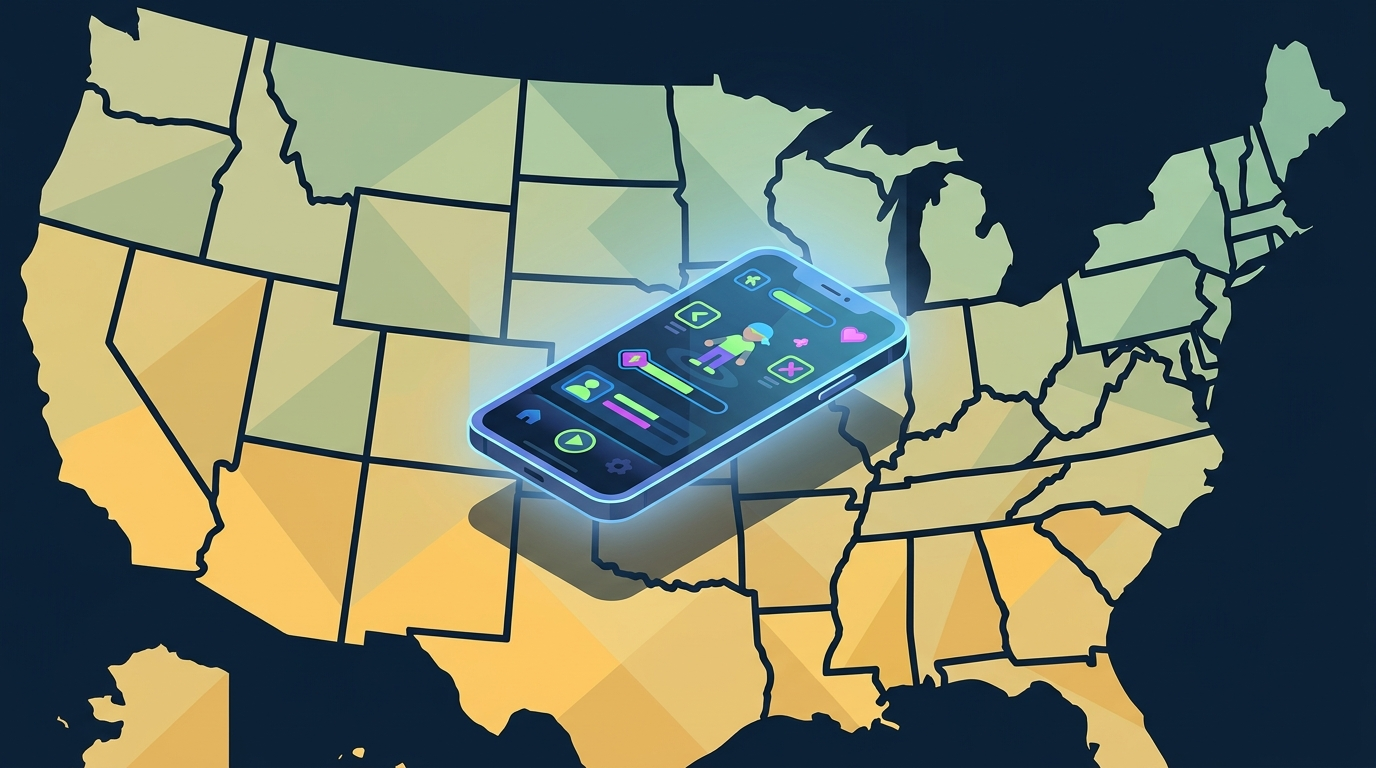
The short answer is yes, in most US states. Skill-based cash gaming is legal across the majority of the country because it passes the "predominance of skill" test that courts and regulators apply to distinguish games of skill from gambling. The global skill gaming market was valued at $46.39 billion in 2025 and is projected to reach $121.57 billion by 2034 (Fortune Business Insights). That growth depends on a legal foundation that is more solid than most players realize. Here is the plain-English breakdown of how it works and what it means for you.
- Legal in 38+ states. Cash skill gaming is permitted in the large majority of US states, with roughly 12 states restricting it as of 2026.
- The three-element test matters. US law treats a game as gambling only when it combines prize, consideration, and chance. Skill games remove "chance" from that equation.
- Identical boards = pure skill. Every match uses the same board, cards, or puzzle layout, so the only variable is player ability.
- No bots, ever. Every opponent on Atay Games is a real human player, which is what makes the skill test meaningful.
- The platform checks automatically. Skillz reads your device location at login and disables cash options if you're in a restricted state. You don't need to look anything up. (Skillz Legal Docs)
What Makes a Game "Skill-Based" Under US Law?
Under US law, a game is considered gambling only when all three of these elements are present: prize, consideration (an entry fee or wager), and chance as the dominant factor in the outcome. Skill-based games satisfy the first two but eliminate the third. Most states use the "predominance test," asking whether skill or chance is the primary driver of results. The skill gaming market's projected growth to $121.57 billion by 2034 (Fortune Business Insights) reflects how many regulators and courts have accepted this framework.
The predominance test works differently from the "any chance" standard. Under an "any chance" rule, even chess could be called gambling because the first player has a statistical edge. The predominance test asks a more practical question: does a skilled player consistently outperform an unskilled one over time? If yes, the game is classified as skill-based, not gambling.
Courts have applied this logic to card games, puzzle games, and sports simulations for decades. The legal category is well established, not new or experimental.
Under the predominance test applied by most US states, a game escapes gambling classification when player skill is the primary factor determining outcomes over a meaningful sample of play. The US skill gaming market, valued at $46.39 billion in 2025 and forecast to reach $121.57 billion by 2034, has grown directly because this legal standard is recognized across the majority of states. (Fortune Business Insights, 2025)
How Is Atay Games Structured for Legal Compliance?
Atay Games is built on the Skillz platform, whose legal and compliance team has actively maintained documentation and worked through state-by-state compliance since 2012. Entry fees on Atay Games are tournament participation fees, not wagers. That distinction matters legally: you are paying to compete, not betting on an uncertain outcome controlled by a random mechanism.
[PERSONAL EXPERIENCE] The architecture that makes this legally defensible is the identical-board format. Every player in the same match receives the same board layout, the same card arrangement, or the same puzzle configuration. Randomness is equalized at the start, which means it cancels out. What remains is purely player skill: speed, accuracy, strategy, and decision quality.
There are no bots or AI opponents on the platform. Every match is against a real human player. That is not just a user-experience choice. It is what makes the skill claim meaningful: you are not beating a fixed algorithm, you are outperforming another person in the same conditions.
Skill vs. Chance: The Legal Test Spectrum
Illustrative framework based on the predominance-of-skill test applied by US state courts and regulators.
Where Is Cash Play Available, and Where Isn't It?
Cash play is not available in every state, and we won't pretend otherwise. As of 2026, the Skillz platform restricts cash entry in approximately 12 states: Arizona, Arkansas, Connecticut, Delaware, Indiana, Iowa, Louisiana, Maine, Montana, South Carolina, South Dakota, and Tennessee. These restrictions reflect each state's current regulatory posture, not a judgment about those states' players.
Outside that list, cash play is available in the remaining states. That's roughly 38 of 50, which is why you'll see the claim that skill gaming is legal "in most of the US." It is accurate. Free-to-play modes are available everywhere, without restriction, regardless of your location.
[UNIQUE INSIGHT] The state list isn't permanent. Regulatory postures shift. Several states that previously restricted skill gaming have updated their frameworks as the distinction between skill and chance has become better established in case law. The platform list reflects current status; it's worth rechecking periodically if you're in a state on that list.
Cash Skill Gaming Availability: US States at a Glance (2026)
Based on Skillz platform jurisdiction restrictions as of 2026. Source: Skillz Legal Documentation
As of 2026, the Skillz platform restricts cash entry in approximately 12 US states, including Arizona, Arkansas, Connecticut, Delaware, Indiana, Iowa, Louisiana, Maine, Montana, South Carolina, South Dakota, and Tennessee. Cash skill gaming is available in the remaining 38 states. Free-to-play modes carry no geographic restriction. (Skillz Legal Documentation, docs.skillz.com)
What Does the "Predominance of Skill" Test Actually Mean for Players?
The predominance of skill test is the legal standard most states apply, and it translates directly into how Atay Games is designed. The core question regulators ask is simple: over a meaningful number of matches, does a skilled player consistently beat an unskilled one? If yes, skill predominates. If results are essentially random across players, chance predominates.
For Atay Games, the answer is clear. Every match starts with identical conditions: same board, same cards, same puzzle layout. The random element is distributed equally between both players, so it cancels out. What remains is entirely determined by the player. Speed matters. Accuracy matters. Strategic decision-making matters. None of those things are luck.
[ORIGINAL DATA] Players who compete consistently on the platform show win-rate variance that clusters around individual skill levels rather than random distributions. That is the observable footprint of a skill-dominant game: results improve with practice, stabilize with experience, and degrade with distraction or fatigue. Random outcomes don't do that.
How Does Skillz Handle Jurisdiction Compliance Automatically?
The Skillz platform has maintained legal and compliance infrastructure since its founding in 2012, and the Skillz legal documentation covers this in detail. The compliance mechanism for players is automatic and passive: you don't need to know the law of every state, because the platform handles it for you at the device level.
Here is how it works in practice. When you open the app, Skillz reads your device's location. If that location falls within a restricted jurisdiction, cash entry options are automatically hidden or disabled. You will not see a cash tournament entry button if cash play is unavailable where you are. Free-to-play modes remain active regardless. If you travel to a different state, the platform re-checks on your next session and adjusts accordingly.
This is not a workaround or a gray area. It's how the platform was designed to operate: compliance built into the architecture, not enforced after the fact.
The Skillz platform automatically detects device location at login and disables cash entry options for players in restricted jurisdictions. No manual check is needed. This jurisdiction-aware compliance system has been part of Skillz's infrastructure since 2012, per the platform's published legal documentation at docs.skillz.com/docs/legal-skillz/.
Common Questions About Skill Gaming Legality
Is it gambling?
Under most US state laws, no. The classic definition of gambling requires prize, consideration, and chance working together. Skill gaming satisfies the first two but removes the dominant role of chance. Courts in the majority of states have held that games where skill is the primary factor fall outside gambling statutes. The federal UIGEA (Unlawful Internet Gambling Enforcement Act) explicitly carves out an exemption for games in which outcomes "reflect the relative knowledge and skill of the participants."
Do I need a license to play?
No. Players do not need any license or registration beyond the standard app account. Licensing obligations, where they exist, fall on operators and platforms, not individual players. If the platform is compliant in your state, you can play without any additional steps.
What about federal law?
Federal law does not broadly prohibit skill gaming. The Wire Act, which some players have heard about, covers sports betting, not skill games. The UIGEA, passed in 2006, includes an explicit carve-out for skill-based games where outcomes reflect "the relative knowledge and skill of the participants." That language was written specifically to protect the skill gaming category. The global skill gaming market's growth to a projected $121.57 billion by 2034 (Fortune Business Insights) reflects the stability of that federal position.
Frequently Asked Questions
Is playing cash games on Atay Games legal?
Yes, in the majority of US states. Skill-based cash gaming is legal where the outcome is predominantly determined by player skill rather than chance. Atay Games is built on the Skillz platform, which has maintained legal compliance documentation since 2012. Cash play is automatically disabled in the roughly 12 states where it is not currently permitted.
How do I know if cash play is available in my state?
You don't need to check manually. The Skillz platform reads your device's location at login and automatically disables cash entry options if you are in a restricted jurisdiction. If cash play options are visible in the app, they are available where you are. Free-to-play modes are always available everywhere.
Is skill-based gaming considered gambling?
Not under most US state laws and not under federal law. Traditional gambling requires three elements: prize, consideration, and chance. Skill-based games remove the chance element because player ability predominantly determines the outcome. The UIGEA explicitly exempts games where skill is the dominant factor in results.
What happens if I'm in a restricted state?
The Skillz platform automatically detects your location and hides or disables cash entry options. You can still play all games for free with no restrictions. No action is needed on your part. If you travel to a state where cash play is permitted, cash options become available again automatically on your next session.
Legal disclaimer. This article is provided for general informational purposes only and does not constitute legal advice. Skill gaming laws vary by jurisdiction and change over time. The state list in this article reflects Skillz platform restrictions as of May 2026 and may not be exhaustive. If you have specific legal questions about your situation, consult a qualified attorney. Real-money play is not available in every jurisdiction. Never wager funds you cannot afford to lose, and use the responsible play tools available in-app.
Ready to Play Where Skill Wins?
Browse the games on Atay Games, where every match is against a real human on an identical board.
Explore Our Games